GEO vs SEO: What's Different and What Stays the Same
GEO and SEO share a foundation but chase different results. Here is a side-by-side comparison, what really changes, and which one your business should work on first.

See if ChatGPT recommends you
Rankfly tracks your visibility in ChatGPT, Claude, Gemini and Perplexity, then writes the articles that close the gaps.
Check my AI visibilityKey takeaways
- SEO earns rankings and clicks on search engines, while GEO earns mentions and citations inside AI-written answers.
- GEO is not a replacement for SEO: crawlable, helpful, well-structured pages are the shared foundation of both.
- Ranking on Google does not guarantee an AI citation, so each channel needs its own measurement.
- Most small businesses should fix SEO basics first, then shape the same pages so AI systems can quote them.
Table of contents
GEO and SEO are not rivals. SEO (search engine optimization) earns your pages rankings and clicks on Google and Bing, while GEO (generative engine optimization) earns your brand mentions and citations inside answers written by AI tools like ChatGPT, Gemini and Perplexity. For most businesses, the right move is SEO first, then GEO built on the same pages.
One quick warning on terms. In this article, GEO means generative engine optimization. Some agencies also use GEO to mean geo-targeted SEO, which is ranking for searchers in a specific city or country. Ask which one a vendor means before you agree on a price.
Quick verdict: which one wins?
Neither. They answer different questions and share most of their work.
- SEO answers: where do we rank when someone searches?
- GEO answers: are we named when someone asks an AI assistant?
- Together, they cover the two places your buyers now look for answers.
If your site is not crawlable, has thin content or ranks for nothing, start with SEO. If you already rank and want to know whether AI assistants recommend you, add GEO. The rest of this guide shows you exactly how they differ.
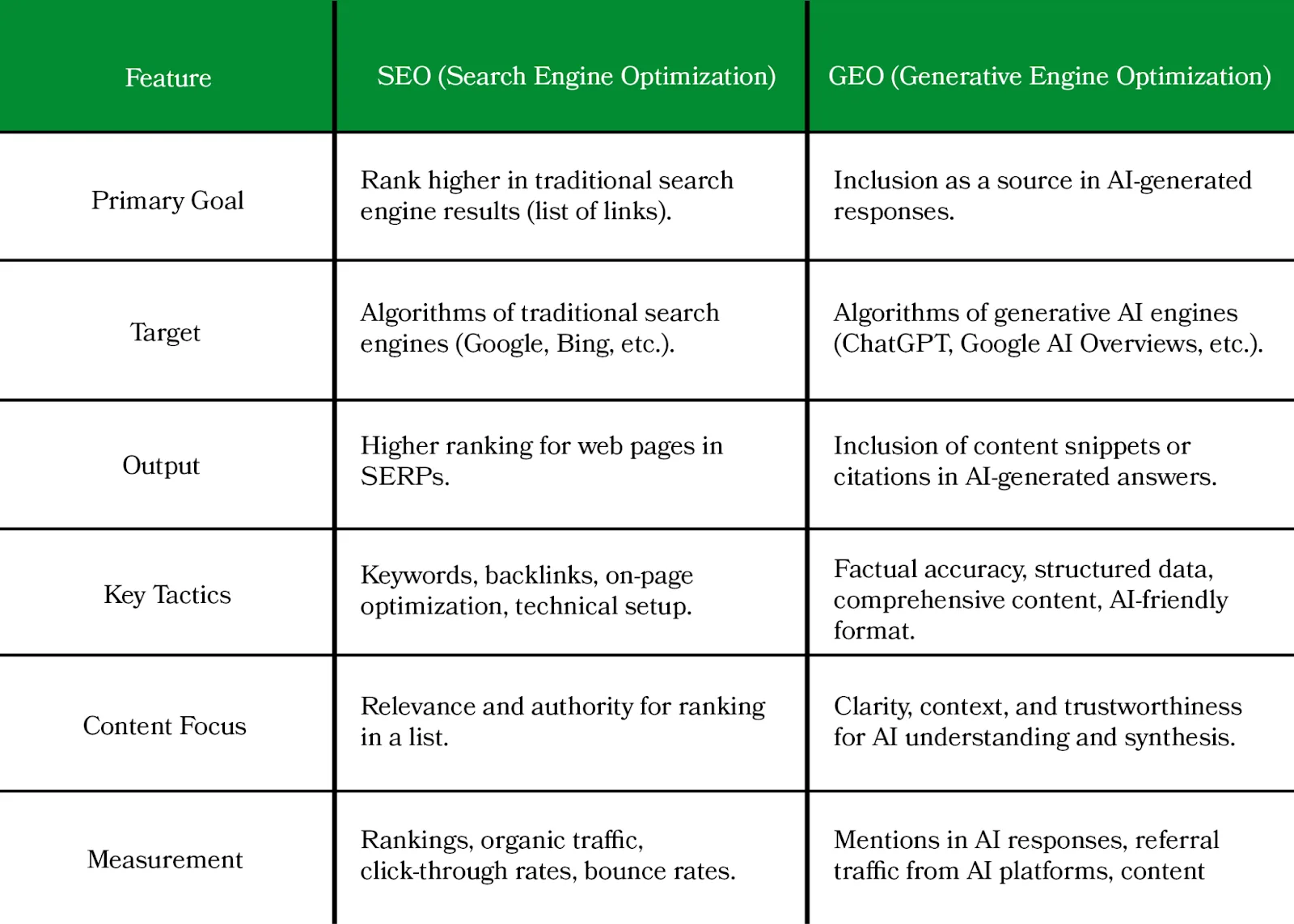
GEO vs SEO side by side
| SEO | GEO | |
|---|---|---|
| Full name | Search engine optimization | Generative engine optimization |
| Main goal | Rank higher in search results and earn clicks | Be mentioned or cited in AI-generated answers |
| Where you show up | Google and Bing results, snippets, maps | ChatGPT, Gemini, Perplexity, Claude, Google AI Overviews |
| What you win | A ranked link and a visit | A mention, a recommendation or a cited source |
| Content that works | Pages matched to keywords and search intent | Clear, direct, sourced pages an AI can quote |
| Authority signals | Backlinks, site quality, topical depth | Brand mentions, consistent entity information, credible sources |
| Main metrics | Rankings, impressions, clicks, conversions | Prompt appearances, citations, share of voice, AI referral traffic |
| Relationship | The foundation | Builds on that foundation |
This table reflects how most practitioners draw the line today. The boundary is still fuzzy, and different experts group the work in slightly different ways.
What is SEO?
SEO is the practice of improving a website so search engines can find it, understand it and rank it for the searches your customers make. The usual work covers keyword research, on-page optimization, technical health, helpful content and earning links.
Success is measured in rankings, organic traffic, click-through rate and conversions. It is the most proven of the two disciplines, with decades of documentation and tooling behind it.
What is GEO?
GEO is the practice of improving the chances that AI systems find, understand, quote or recommend your brand and content when they write an answer. The term was named in a 2024 research paper and is now used widely by marketers.
Instead of fighting for position ten blocks of blue links, you are trying to become a source an AI trusts enough to cite. That means clear answers, verifiable facts and a brand that shows up consistently across the web.
If you prefer a walkthrough, this video explains the practical difference between the two.
How are GEO and SEO different?
The two share a lot of work, but five things genuinely change. Here they are one by one.
1. The goal: a click versus a mention
SEO aims to put your link in front of a searcher so they visit your site. GEO aims to put your brand or your facts inside the answer itself. Sometimes the AI links to you, sometimes it only names you, and sometimes a buyer reads the answer and never visits any site.
That shift matters because Pew Research reported that Google users are less likely to click on links when an AI summary appears in the results. Being named in the answer is becoming part of the job, not a bonus.
2. The surface: a results page versus a written answer
An SEO result is a ranked list that you can scan and compare. A GEO result is a short synthesized answer that picks a handful of sources and often names two or three businesses. There is no page two.
The sources also differ between products. Researchers at NJIT, NTU and Indiana University Bloomington found that Google search, AI Overviews and Gemini retrieved largely different sources, with average Jaccard similarity below 0.2. Their data covers Google products only and was collected in December 2025. They also found AI Overviews appeared for 51.5% of representative real-user queries, as reported in Grossman et al., SIGIR 2026. The practical lesson: ranking well in Google search does not guarantee you appear in an AI answer.
3. The content: keyword match versus quotable clarity
SEO content is built around a keyword and the intent behind it. GEO content is built so that a model can lift a sentence and be confident it is correct.
In practice, that means:
- A direct answer in the first two sentences of each section.
- One-sentence definitions that make sense out of context.
- Specific facts, numbers and named examples, with sources.
- Tables and lists that a model can parse cleanly.
- FAQ sections written in the way people actually ask.
Good SEO content already does most of this. GEO simply raises the bar on clarity and verifiability.
4. The authority signals: links versus mentions
SEO leans heavily on backlinks and site quality. GEO adds a second layer: how consistently your brand is described across the web. If your name, services and location appear the same way on your site, your profiles and third-party pages, AI systems have less reason to guess or skip you.
Backlinks still matter for the ranking side, so this is an addition, not a swap.
5. The measurement: stable rankings versus shifting answers
A keyword rank is easy to check and fairly stable from day to day. An AI answer can change from one run to the next and between assistants, so a single check tells you little. GEO measurement is about patterns over time: how often you appear across a fixed set of buyer questions, who appears instead, and which sources get cited.
| Metric | SEO | GEO |
|---|---|---|
| What you check | Keyword positions, clicks, impressions | Whether you are named for a set of buyer questions |
| Tool type | Search Console, rank trackers | Prompt tracking across AI assistants |
| How often | Weekly or monthly trends | Repeated checks, because answers vary |
| Good result | Higher rank, more qualified traffic | More mentions, better position and sentiment, cited sources |
| Competitor view | Who outranks you | Who the AI recommends instead of you |
You can run a quick one-off check with the free AI Visibility Checker to see where you stand today.
What stays the same?
More than most headlines suggest. Both disciplines reward the same core habits, and some practitioners argue that GEO fails without them because AI answers draw on publicly indexed content, links and authority signals.
- Crawlable and indexable pages. If a search engine cannot reach a page, an AI that relies on search results cannot either.
- Helpful, original content. Pages that answer a real question better than the alternatives do well in both.
- Search intent. Knowing what people actually ask drives both keyword choice and AI prompts.
- Clear structure. One H1, descriptive headings, short paragraphs and internal links help people, crawlers and models.
- Trust. Real authors, accurate facts, sources and dates help in both worlds.
- Technical health. Speed, mobile layout and clean markup are shared groundwork.
If you want to confirm your basics, work through the free SEO Checklist before spending anything on GEO.
Where do AEO and AIO fit in?
Two more acronyms show up in this conversation, and they are easy to mix up.
- AEO (answer engine optimization) focuses on short, direct answers: definitions, FAQs, steps and featured snippets.
- AIO (AI optimization) is used by some agencies to mean using AI tools to speed up SEO work, rather than optimizing for AI platforms.
- AI SEO is a loose umbrella label for optimizing for AI-driven search experiences, and in practice it usually means GEO plus AEO.
You do not need three separate strategies. Think of it as layers on one page: SEO gets it found, AEO makes the answer scannable, GEO makes it citable.
| Layer | What it does | Typical page element |
|---|---|---|
| SEO | Gets the page crawled, indexed and ranked | Keyword-matched title, headings, internal links |
| AEO | Gives a direct, snippet-friendly answer | Definition, FAQ, numbered steps |
| GEO | Makes the page and brand quotable by AI | Sourced facts, tables, consistent brand details |
Is SEO dead because of AI search?
No. People use both, and AI tools have not replaced search for most buyers. The data points the same way, with caveats.
The growth is real, but so is the other side. Gartner reported that only about one-third of consumers believe GenAI chatbots are as effective as search engines for learning new information, based on two US consumer surveys of 377 and 365 respondents. See the Gartner press release, which advises marketers to optimize for both AI-driven and traditional search.
Take these as snapshots from one agency and one analyst firm, not market-wide measurements. The sensible reading is that SEO is evolving, AI answers are an added channel, and ignoring either leaves customers on the table.
GEO vs SEO: which should you choose?
Choose by where your buyers look and how much authority your site already has. Use this table as a starting point.
| If you are... | Start with | Then add | Why |
|---|---|---|---|
| A new site with little content | SEO | GEO-ready formatting from day one | You need pages that rank and can be quoted before anything else works |
| A local service business | SEO, especially your Google Business Profile | GEO checks on the questions customers ask | Local results and AI answers are separate visibility problems |
| An online store | SEO for category and product pages | GEO for comparison and how-to questions | Buyers often ask AI which product to pick |
| A SaaS or B2B company | Both from the start | Competitor tracking in AI answers | Software buyers often research with AI assistants before they visit a site |
| A publisher or affiliate site | SEO | GEO to protect brand mentions | Clicks may fall when AI summaries appear, so being cited matters more |
| A site that already ranks well | GEO | Ongoing prompt tracking | The foundation exists, so check whether AI names you |
If you run a small business
Pick one move per month. First fix crawling, titles and your core service pages. Then rewrite the top pages so each opens with a direct answer and includes a table and a short FAQ. Our page on SEO for small businesses covers the basics in more detail.
If you are a founder with no SEO time
Your constraint is consistency, not knowledge. Publishing one well-structured, sourced article a day beats a perfect article once a quarter, because both Google and AI assistants favor sites with real depth on a topic.
If you are a marketer reporting to a boss
Keep SEO reporting as is and add one GEO view: a fixed list of buyer questions, checked on a schedule, showing whether you appear and who appears instead. That gives leadership a number to follow without replacing the metrics they already trust.
How to work on SEO and GEO together
You do not need two workflows. Use one set of pages and run these steps in order.
- Check the basics. Confirm your key pages are crawlable, indexed and load fast.
- List real buyer questions. Use search suggestions and People Also Ask boxes, then write down the 20 questions a buyer would put to an AI assistant.
- Lead with the answer. Open each page and each section with a direct answer in the first two sentences.
- Add quotable structure. Include one-sentence definitions, a table, a short list and a short FAQ on every important page.
- Mark it up. Add structured data where it fits, using the free Schema Markup Generator and FAQ Schema Generator.
- Cite your sources. Link to primary sources for every number, and keep your own facts accurate and dated.
- Keep your brand details consistent. Use the same business name, services and location across your site and profiles.
- Track and revisit. Check the same questions on a schedule, find the ones where a competitor is recommended instead, and write or improve a page for each gap.
Common mistakes to avoid
- Treating GEO as an SEO replacement. It builds on SEO, it does not replace it.
- Buying a GEO package with guaranteed AI mentions. No one controls what an AI writes, so a guarantee is a red flag.
- Stuffing keywords or buzzwords. Thin, repetitive copy fails in both channels.
- Using schema without visible content. Markup should describe real text on the page, not stand in for it.
- Judging by one prompt. AI answers vary, so one lucky or unlucky check proves nothing.
- Skipping measurement. If you never check whether AI names you, you cannot tell what is working.
Where Rankfly fits
If your real goal is getting found on Google and in AI answers without doing the work yourself, Rankfly is built for that. It is an SEO autopilot for small businesses, founders and marketers. It finds keywords you can realistically win, then researches the current top 10 results and writes one SEO article a day in your brand's voice, with internal links, sources, an FAQ and a featured image.
On the GEO side, AI visibility tracking asks ChatGPT, Claude, Gemini and Perplexity the questions buyers ask. It shows your visibility score, share of voice, position, sentiment and cited sources against up to 3 competitors across 20 tracked questions. Gaps where competitors are recommended become articles, and each one is re-checked 14 days after it goes live. Plans start at $66 a month for 30 articles with a 3-day free trial, and you can see the details on the pricing page. Rankfly is not a full SEO suite like Semrush or Ahrefs. It is for small teams that want the content researched, written and published for them.
Final thoughts
SEO gets you ranked and GEO gets you named, and the best pages do both from the same foundation. Fix your basics, write pages that answer questions directly and with sources, then check whether AI assistants recommend you and fill the gaps you find.
Frequently asked questions
What is a GEO search?
A GEO search usually means a question put to an AI assistant, where the answer is written by a generative model and may name or cite businesses. The term can also mean a location-based search, such as plumber near me, so check the context. In this article, GEO means generative engine optimization.
What is AI SEO?
AI SEO is a loose label for optimizing your website for AI-driven search experiences like ChatGPT, Gemini, Perplexity and Google AI Overviews. In practice it overlaps heavily with GEO and AEO. Some agencies also use it to mean using AI tools to do SEO work faster.
Is SEO dead or evolving in 2026?
SEO is evolving, not dead. Surveys show AI tool use for search is growing, but Gartner found only about one-third of consumers think GenAI chatbots are as effective as search engines for learning new information. Marketers are advised to optimize for both AI-driven and traditional search.
How do I learn SEO as a beginner?
Start with how search engines crawl and rank pages, then practice on your own site: keyword research, clear titles and headings, helpful content and internal links. Use free tools and a checklist to find problems, and change one thing at a time so you can see what works. Google's own documentation is the most reliable reference for the basics.
Is GEO the same as AEO?
No. AEO (answer engine optimization) focuses on short, direct answers such as snippets, definitions and FAQs. GEO focuses on being understood, cited and recommended by generative AI systems, which also depends on entity clarity and brand mentions. They overlap, and good pages usually serve both.
Can I do GEO without doing SEO?
You can, but it is harder. AI answers draw on publicly available content and authority signals, and many practitioners argue weak SEO foundations hold GEO back. Get your pages crawlable, helpful and well structured first, then optimize them for AI citation.
About the editorial team
Emma writes Rankfly's guides on SEO, AI search and getting small businesses found on Google and ChatGPT.