Local SEO for Law Firms: The Google Maps Playbook
A practical guide to getting your law firm into Google's map pack: the ranking factors, the exact steps, the mistakes that cost cases, and a plan you can start this week.

Get found by more customers
Rankfly finds the keywords law firms can win, then writes and publishes an SEO article every day.
Get my free planKey takeaways
- Local SEO for law firms is the work of showing up in Google's map pack and local results when someone nearby searches for a lawyer.
- Google ranks local results on relevance, distance, and prominence, and you can only change two of the three quickly: relevance and prominence.
- Your Google Business Profile, consistent name, address and phone details, and steady real reviews do most of the work.
- Location pages with unique content, local citations in legal directories, and local mentions support the profile and your organic rankings.
- You can complete the core setup in one week, then keep it going with a few weekly habits.
Table of contents
Local SEO for law firms is the process of getting your firm to appear in Google Maps and the local pack when people nearby search for a lawyer. Google decides who appears based on relevance, distance, and prominence, so your job is to make your Google Business Profile, website, reviews, and online mentions prove all three.
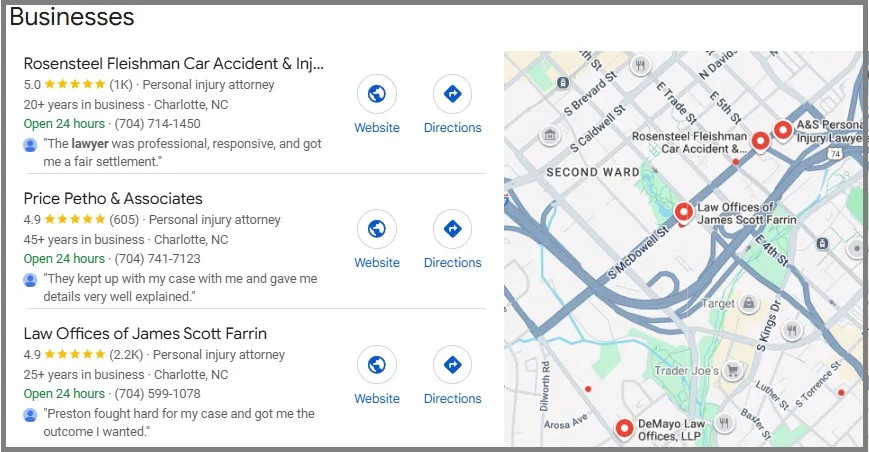
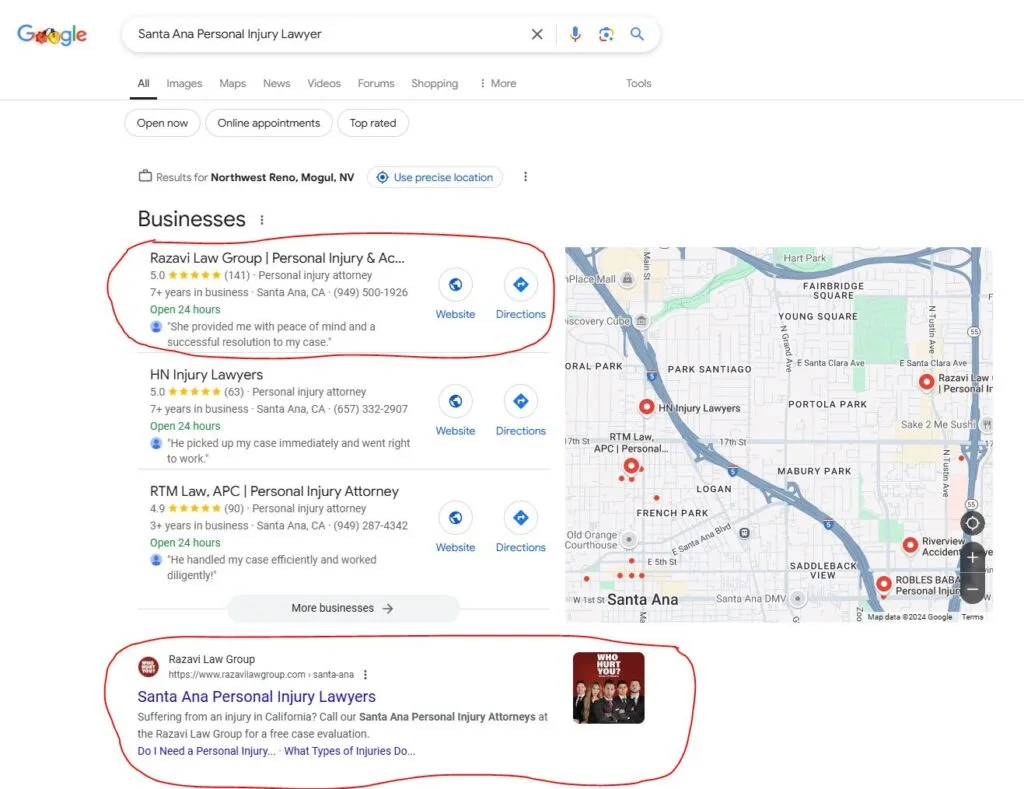
This guide focuses on the map pack, the block of three listings with a map that sits near the top of the results for searches like 'divorce lawyer near me.' You will get the ranking factors, a step-by-step setup, the mistakes that hold firms back, and a short plan for this week.
What is local SEO for law firms?
Local SEO for law firms is a set of tactics that helps a legal practice rank in Google's map pack and local organic results for searches tied to a place, such as 'Miami personal injury lawyer' or 'family attorney near me.'
It differs from regular SEO in one big way. Google compares the searcher's location to your office location. Two firms with identical websites can rank very differently for the same search, depending on where the person is standing.
Local SEO has three parts:
- Your Google Business Profile (GBP): the listing that shows in Google Maps and the map pack.
- Your website: the pages that prove you serve a place and a practice area.
- Your off-site signals: reviews, directory listings (citations), and local mentions.
If you want the general version of this for any local business, see our local SEO guide for small businesses.
Why the map pack matters for lawyers
People who search for a lawyer often need one soon, and they pick from what they see first. The map pack sits above the regular organic results, and it shows phone numbers, ratings, and directions at a glance.
The same agency also reports that Google is testing AI-generated local summaries on mobile that show fewer firms than the traditional three. If that spreads, fewer spots will be available, which makes a strong profile more valuable, not less.
How Google ranks local results: relevance, distance, prominence
Google states that local results are based primarily on relevance, distance, and prominence, combined to find the best match for a search. You can read the details in Google's help page on improving local ranking.
| Factor | What Google looks at | What you can do |
|---|---|---|
| Relevance | How well your listing matches the search | Choose the right categories, list your practice areas, write pages for each service and city |
| Distance | How far your office is from the searcher | Little in the short term. Make sure your address is accurate and your service area is set correctly |
| Prominence | How well known and trusted you are | Earn reviews, get listed in quality directories, win local mentions and links |
Distance is the one you cannot change quickly. A firm on the outskirts of a city is less relevant for searches in the city center than a firm downtown, and that is normal. It does not mean you cannot rank. It means you need to do more with relevance and prominence to compete.
Step 1: Claim and verify your Google Business Profile
If your firm has no verified profile, it generally cannot show in the map pack. Start at Google's guide to setting up your Business Profile and finish verification.
Search for your firm first. Someone may have already created a listing, such as a former partner or a directory. Claim that listing rather than making a duplicate, because duplicates split your reviews and confuse Google.
Use one profile per real office. Each location needs a staffed, street-level address where clients can actually visit or where you actually work. P.O. boxes and shared virtual offices put your profile at risk of suspension.
Step 2: Choose the right categories
Your primary category is one of the strongest relevance signals on your profile. Pick the one that matches your main practice, such as Personal Injury Attorney, Criminal Justice Attorney, or Divorce Lawyer, rather than a broad label like Lawyer.
Then add a few secondary categories for your other services. Only add what you truly do. Google adds new niche categories over time, so review the list every few months and switch to a more exact one if it appears.
Step 3: Use your real firm name
Some agencies advise adding keywords and cities to your business name, because listings with keywords in the name often do rank higher. It is also against Google's guidelines, which ask for your real-world name as it appears on your signage, website, and stationery. Firms that stuff keywords risk having the profile suspended, and a suspended profile means no map pack at all.
The safer path is to use your actual name and win on the other signals. If you do rebrand, change everything at once: legal registration, signage, logo, website, and every listing.
Step 4: Write a strong business description and fill every field
You get 750 characters for the description. It is not a major ranking factor on its own, but it helps people decide to call, and it should read like a person wrote it.
A simple template:
[Firm name] is a [practice area] law firm serving [city] and [nearby areas]. We handle [three or four case types]. [Lead attorney] has [X] years of experience in [practice area]. Call for a free consultation.
Then complete everything else:
- Hours. Keep them accurate, including holidays. If you offer 24/7 intake by phone, say so.
- Phone number. Use a local number that matches your website, not only a toll-free line.
- Services. List each practice area as a service, with a short description.
- Appointment link. Point it to a consultation booking page.
- Website link. Link to your homepage for a single-office firm or to the matching location page for a multi-office firm.
Step 5: Add real photos, posts, and answers
Use photos of your actual office, entrance, and team. Real images build trust, and clients like to know who they will meet. Skip stock photos.
Post updates regularly. Share a case result summary you are allowed to publish, a seminar, a community event, or a short legal tip. Posts will not carry a weak profile, but they keep it active and give visitors a reason to click.
Answer common questions in the Q&A section yourself, and add the questions clients really ask: consultation fees, languages spoken, whether you take cases on contingency. Check your state bar rules before publishing anything that could count as advertising.
Step 6: Make your name, address, and phone number consistent
NAP stands for name, address, and phone number. Consistency means these details match across your website, your Google profile, and every directory that lists you.
Inconsistency usually appears after an office move, a rebrand, or when a marketing agency uses a tracking number on some listings. Here is a typical problem:
| Source | Listing |
|---|---|
| Website | Smith Law Firm, 100 Main St, Suite 100, Tampa, FL, (813) 555-0100 |
| Google profile | Smith Law Firm, 100 Main Street Ste 100, Tampa, FL, (813) 555-0100 |
| Old directory | Smith & Associates, 22 Bay Ave, Tampa, FL, (813) 555-0199 |
The third row is the one that hurts. Minor formatting differences are usually harmless, but a wrong address or an old firm name makes Google less sure which details are correct.
To find old listings, search your firm name together with any former address or phone number. When you find a wrong listing, ask the site to update it or fix it in your account on that directory.
Step 7: Build citations in the right directories
A citation is any mention of your firm's name, address, and phone number on another website. For lawyers, the most useful ones come from legal directories and local sites.
Start with the biggest general and legal directories, for example Yelp, the Better Business Bureau, Justia, FindLW alternatives like Avvo and Nolo, and Martindale. Then add:
- Your state and local bar association member directory.
- Your local chamber of commerce.
- Local news or magazine directories in your area.
- Directories tied to your practice area, such as a family law or estate planning association.
Two useful research lists are Whitespark's top citation sources for the United States and BrightLocal's list of citation sites for attorneys. Quality matters more than quantity. Ten accurate listings on real sites beat a hundred on junk directories.
Step 8: Earn reviews the right way
Reviews help you in two ways. They persuade the person deciding between three firms, and they give Google context about your services. When clients mention a service, such as a DUI or a car accident, in their review text, that helps tie your firm to that topic.
How to ask for reviews
Google allows you to ask clients for reviews, and its review policy explains what is not allowed. The rules in plain terms: do not offer incentives, do not ask only for positive reviews, and do not post fake ones.
- Create a direct review link from your Business Profile.
- Send it by email or text at a natural moment, such as when a case closes well.
- Keep the message short and personal.
- Send one polite follow-up to people who do not respond.
A simple template:
Hi [Name], thank you for trusting us with your case. If you have a minute, an honest review helps other people in [city] find the right lawyer. Here is the link: [link]. Thank you.
Check your state bar's advertising and testimonial rules before you start. They vary by state, and you are responsible for them.
How to respond
Reply to every review, positive or negative, within a few days. Never confirm that someone was a client or share any case detail in a public reply, even to correct the record. A calm, general response such as 'We take feedback seriously, please contact our office' protects confidentiality and shows prospects how you handle problems.
Aim for a steady flow rather than a burst. A trickle of new reviews each month looks natural and signals that your firm is active.
Step 9: Optimize your website for local relevance
Your profile gets you into the pack, and your website shows Google why you are the best answer for each practice area and city.
The basics on every page
- Put your name, address, and phone number in the footer and on the contact page, as text rather than an image.
- Make the phone number click-to-call on mobile.
- Write title tags that include the practice area and city, for example 'Tampa Personal Injury Lawyer | Smith Law Firm.' Our free SEO title generator can help you draft them.
- Embed a Google Map on the contact page.
Location and practice area pages
Create a separate page for each office and for each major practice area in each city you want to win. Do not copy one page and swap the city name. Pages like that are thin, and Google may not index them.
Make each page useful for that place:
- Which courthouses you appear in.
- State and local laws that matter to this type of case.
- Neighborhoods and nearby cities you serve.
- Attorney bios, case types, and FAQs for that area.
- Directions and parking for the office.
Add local schema
Schema markup is code that tells search engines the facts about your business in a structured way. For a law firm, LocalBusiness or its legal subtypes (such as LegalService and Attorney) describe your name, address, phone, hours, and service area. See schema.org's LocalBusiness type for the properties, or generate the code with our free local business schema generator and paste it into your site.
Step 10: Build local prominence beyond directories
Prominence is partly about how well known you are in your area. Real-world activity creates the online mentions that count.
- Sponsor a local charity event, youth league, or bar association function.
- Speak at a seminar or write a guest article for a local publication.
- Get quoted by local reporters on legal topics where you have expertise.
- Ask partner professionals, such as accountants or doctors who refer clients, whether they would list your firm.
Each mention that links to your website helps your organic rankings as well as your map pack position. Where it is natural, the link text can include your practice area and city, but do not overdo it.
Local SEO priorities at a glance
| Task | Effort | Impact | How often |
|---|---|---|---|
| Verify and complete Google Business Profile | Low | High | Once, then review quarterly |
| Fix categories | Low | High | Once, then review twice a year |
| Request reviews | Low | High | Weekly |
| Fix NAP inconsistencies | Medium | Medium to high | Once, then check twice a year |
| Build legal and local citations | Medium | Medium | Once, then add as you find new ones |
| Location and practice area pages | High | High | Add one at a time |
| Local schema | Low | Medium | Once |
| Local mentions and links | High | Medium to high | Ongoing |
Common local SEO mistakes law firms make
- Keyword-stuffing the business name. It can work for a while and then lead to suspension.
- Using a virtual office or P.O. box address. Google can verify and suspend profiles that are not real, staffed offices.
- Letting reviews go unanswered. Prospects read both the reviews and your replies.
- Buying or faking reviews. It violates Google's policy and can bring penalties and legal trouble.
- Revealing client details in replies. This is an ethics problem, not just an SEO one.
- Creating city pages with the same text. Thin, duplicate pages rarely get indexed.
- Wrong or outdated listings. Old addresses and phone numbers from a previous office keep hurting after you move.
- Using a tracking number everywhere. If you need call tracking, keep your main local number as primary and make sure it is consistent.
- Setting up once and never touching it again. Hours change, categories change, and competitors keep adding reviews.
Tools that help with law firm local SEO
| Tool | What it does | Notes |
|---|---|---|
| Google Business Profile | Manages your Maps and pack listing | Free, essential |
| Local Falcon | Shows your map ranking across a grid of locations | Useful because rankings change block by block |
| Whitespark | Finds competitor citations and citation sources | Paid, with a limited free version |
| Moz Local | Distributes your listings and checks consistency | Paid, check current pricing |
| Local business schema generator | Creates the structured data code | Free |
| Keyword rank checker | Tracks where your pages rank for a keyword | Free |
| Free local SEO checklist | Walks through the core local tasks | Free |
Grid-based rank trackers matter because map pack results depend on where the searcher is. A single ranking number from your office can look better than what a prospect across town sees.
How Rankfly fits in
Rankfly does not manage your Google Business Profile or request reviews for you. It handles the content side of local SEO: it finds keywords your site can realistically rank for, then writes and publishes one researched article a day with internal links, sources, and an FAQ. That is useful for practice area and city topics your site has never covered.
Law firms often need sign-off on anything published, and Rankfly's review mode lets you approve each article before it goes live. It also asks ChatGPT, Claude, Gemini, and Perplexity the questions your buyers ask and shows whether your firm is recommended, so you can see gaps beyond Google. Pricing is $66 a month for 30 articles, with a 3-day free trial. See the AI visibility tracker and pricing for details.
A local SEO plan for this week
You can finish the foundation in five working days.
- Monday: profile. Claim and verify your Google Business Profile, set your primary and secondary categories, and write the description.
- Tuesday: details. Add services, hours, the appointment link, and at least ten real photos of your office and team.
- Wednesday: NAP audit. Write down your exact name, address, and phone number, then search for old versions and list every directory that has errors.
- Thursday: reviews. Create your review link, write the request message, and send it to your most recent satisfied clients, following your bar's rules.
- Friday: website. Check that your NAP is text in the footer, your title tags include the practice area and city, and your local schema is live.
Then add weekly habits: ask for reviews, reply to every review, add a post or photo, and publish one useful local page or article. Use the free keyword generator to find city and practice area searches worth writing for.
Final thoughts
Winning the map pack comes down to a complete, honest Google Business Profile, consistent details everywhere, steady real reviews, and a website with useful pages for each city and practice area. Do the core setup this week, then keep up the weekly habits. If you want the content side handled for you, Rankfly can do it.
Frequently asked questions
How long does local SEO take to work for a law firm?
Profile fixes can change your visibility within weeks, but competitive markets often take several months of steady work on reviews, citations, and content. Results depend on your competition and how far you are from the searcher, so track your rankings over time rather than judging after a few days.
How do I get my law firm into the Google map pack?
Verify your Google Business Profile, choose the most accurate primary category, keep your name, address, and phone details consistent, and collect steady real reviews. Then support the profile with location and practice area pages on your website and listings in legal and local directories.
How many Google reviews does a law firm need?
There is no official number. Aim for a steady flow of new reviews that mention your services and compare your count and recency with the firms already in the pack for your target search. Follow Google's review policy and your state bar's rules when you ask.
Can a law firm rank in a city where it has no office?
It is harder, because Google weighs distance between the searcher and your office. You can still rank in local organic results with strong location pages, links, and reviews, but you generally cannot create a Business Profile for an office you do not actually have.
Should I put keywords in my law firm's Google Business Profile name?
No. Google's guidelines ask for your real-world business name, and keyword stuffing can lead to suspension. Use your actual name, and compete with categories, reviews, citations, and website content instead.
What is NAP consistency and why does it matter?
NAP stands for name, address, and phone number. When these details match across your website, Google profile, and directories, Google can trust them. Old addresses or mismatched phone numbers can make your firm look less reliable.
About the editorial team
Emma writes Rankfly's guides on SEO, AI search and getting small businesses found on Google and ChatGPT.