Gemini vs ChatGPT: Which Is Better for Business Content?
A plain comparison of Gemini and ChatGPT for business content, based on what reviewers found, with a clear pick for each type of reader and a third option for SEO.

30 SEO articles a month, done for you
Keyword research, writing, publishing and AI visibility tracking for $66/month. 3-day free trial.
See pricingKey takeaways
- ChatGPT is the safer pick for polished business writing and for research you need to fact-check, according to ClickUp and PCMag's reviews.
- Gemini wins if your team works in Google Workspace, needs video or audio analysis, or handles very large documents.
- Consumer plans cost about the same, $19.99 for Google AI Pro and $20 for ChatGPT Plus, so ecosystem should decide, not price.
- Neither chatbot researches keywords, publishes to your site or runs on a schedule, so you still do the SEO workflow by hand.
- If your goal is traffic from Google and AI assistants, a done-for-you tool like Rankfly covers the loop that a chatbot leaves to you.
Table of contents
ChatGPT is the better pick for most business content. Reviewers find its writing more natural, its sources easier to check and its research reports easier to trust. Gemini is the better pick if your team lives in Google Workspace, needs to analyze video or audio, or works with very large documents. Both cost about $20 a month, so price will not decide it.
One gap matters for marketers: neither chatbot researches keywords for you, publishes to your site or works on a schedule. That is the part a tool like Rankfly handles, and we cover it near the end.
Gemini vs ChatGPT at a glance
This table compares the two on the points that matter for business content. Features and plan names change often, so check current pricing before you buy. Details come from ClickUp's June 2026 comparison unless noted.
| Gemini | ChatGPT | |
|---|---|---|
| Maker | OpenAI | |
| Consumer price | $19.99/month (Google AI Pro) | $20/month (ChatGPT Plus) |
| Budget tier | $7.99/month (Google AI Plus) | $8/month (ChatGPT Go) |
| Writing quality | Competent, often generic | Cleaner, more natural, less editing |
| Sources in answers | Cites many, but harder to tie claims to sources | Clear in-text sourcing |
| Workspace integration | Native in Gmail, Docs, Sheets, Meet, Drive | Standalone app, no native suite embedding |
| Context window | 2 million tokens (Gemini 3.1 Pro) | 1 million tokens (GPT-5.5) |
| Video and audio analysis | Native | Not native |
| Custom assistants | Gems, NotebookLM | Custom GPTs, GPT Store |
| Best for | Google Workspace teams, media-heavy work | Drafting, editing, research you must verify |
Which writes better business content?
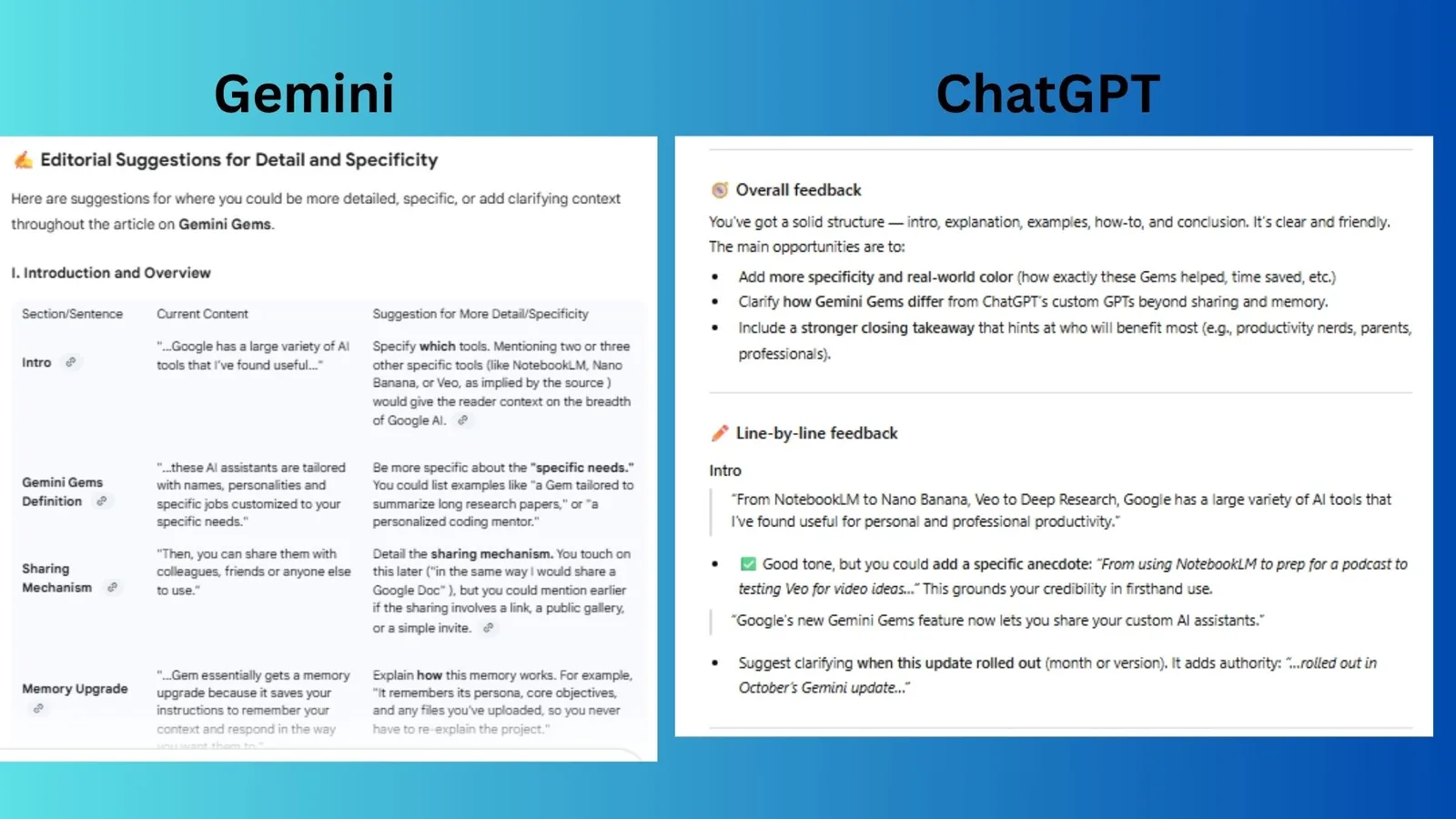
ChatGPT does, by most accounts. ClickUp says its prose is structurally cleaner and needs less editing before professional use. PCMag's review reached the same view for creative writing: ChatGPT's responses are more distinct and follow prompts more closely, while Gemini's can feel repetitive unless you calibrate your requests carefully.
That matters for business content because editing time is the real cost. A draft that sounds like a template needs a human to add voice, examples and a point of view. A draft with varied sentences and clear emphasis needs a lighter pass.
Gemini has one real writing advantage: live Google Search grounding. ClickUp notes that if you are drafting a market brief that needs today's numbers, that access to current data is a genuine edge. Digital Trends also found that Gemini sometimes gives fuller structured answers to open-ended advice questions, where ChatGPT returned a shorter bullet list.
Which is better for research and fact-checking?
ChatGPT is easier to verify. PCMag found that ChatGPT shows article tiles, ties claims to evidence and often gives more detail. Gemini's sourcing in AI Mode and in deep research reports uses clickable carets that do not highlight the relevant part of the response, which makes claims harder to trace.
Gemini does have workflow perks. It often cites more sources than ChatGPT in deep research, and it can export a formatted report to Google Docs in one click. PCMag described its reports as reading like academic papers, while ChatGPT's read more like long forum posts.
Neither is safe to publish without checking. PCMag notes that both chatbots still sometimes make up quotes from provided documents or misread images. OpenAI reported that GPT-5.5 Instant cut hallucinated claims by 52.5% compared with its predecessor on high-stakes prompts, according to ClickUp, but a lower rate is not zero. Treat every statistic, quote and date in an AI draft as unverified until you open the source.
What about accuracy in general?
Both tools are accurate enough to be useful and wrong often enough to be risky. Reviewers who tested complex reasoning found ChatGPT gave correct answers slightly more often, but performance was similar. Check anything with a number, a legal claim or a medical claim in it.
Which fits your tools better?
Gemini fits if you work in Google apps. ClickUp reports that with a Google AI Pro subscription, Gemini drafts emails in Gmail, generates formulas in Sheets, summarizes documents in Docs, takes notes in Meet and organizes files in Drive. You never leave the app. Google describes its business offering on its Workspace AI page.
ChatGPT works as a standalone assistant. It browses, analyzes files, generates images and has a Canvas editor, but it does not embed inside a productivity suite. PCMag adds that ChatGPT has desktop apps for macOS and Windows plus an official Chrome extension, while Gemini has neither.
If your team uses Microsoft 365 or no suite in particular, the Workspace gap will not matter to you. There is no native integration to miss.
Which handles big files and media better?
Gemini does. Per ClickUp, Gemini 3.1 Pro holds 2 million tokens of context, while GPT-5.5 holds 1 million. Gemini also analyzes video and audio natively, so you can upload a recorded customer call or webinar and ask for a summary. ChatGPT needs a transcript first.
Most business content work never gets near either limit. A blog post, a landing page and a competitor's top 10 results fit easily. The gap matters if you feed in whole research libraries, long transcripts or video archives.
Which is better for images and video?
It depends on what you value. PCMag found that ChatGPT's image generation holds up even on complex prompts like diagrams and comic panels, with minimal errors. Gemini generated images faster, but they routinely had noticeable distortion. On video, PCMag called Gemini's Veo 3 best-in-class, partly because it produces matching audio, but that model sat behind the most expensive plan at the time.
Note that PCMag's comparison covered Gemini 2.5 and o3-era ChatGPT models, so image and video quality may have moved since. For blog graphics and social posts, test the same prompt in both.
Custom assistants and ecosystem
ChatGPT has Custom GPTs and a large GPT Store. Gemini has Gems and NotebookLM. PCMag found that neither is a big upgrade over using the chatbot directly, but third-party Custom GPTs add real functions, such as Canva access for editing images. Third parties cannot create Gems, and you cannot share them.
NotebookLM is worth a look for content teams. ClickUp describes it as building a knowledge base scoped to your own documents, with inline citations to the exact passages. That helps when you want a draft grounded in your own product docs or research.
Gemini vs ChatGPT cost
Price is a tie at the consumer level. Per ClickUp, Google AI Pro is $19.99 per month and ChatGPT Plus is $20. Budget tiers sit near $8, and premium tiers reach about $100 and $200 on both sides. The difference is what comes with the plan.
| Plan type | Gemini | ChatGPT | What differs |
|---|---|---|---|
| Free | Yes, with caps | Yes, with caps | Both limit access to the newest models |
| Budget | Google AI Plus, $7.99 | ChatGPT Go, $8 | Near identical |
| Standard | Google AI Pro, $19.99 | ChatGPT Plus, $20 | Google bundles 5 TB storage and YouTube Premium Lite |
| Premium | Google AI Ultra, $99.99 and $199.99 | ChatGPT Pro, $100 and $200 | Near identical |
Source: ClickUp, updated June 2026. Plan names and prices change often, so confirm on each vendor's site.
If you already pay for Google storage, Gemini's bundle makes it cheaper in practice. Both free tiers have usage caps. Google says the number of prompts you can use varies with prompt length, file size and conversation length, per the Gemini Apps FAQ. OpenAI describes its free-tier limits in its free tier FAQ.
If you prefer a video walkthrough of the $20 plans, Parker Prompts compares them side by side.
Privacy: what to know before pasting client data
PCMag found that both tools collect your chats and use them to train models by default, though both let you turn training off. Google does not use Gemini data from Workspace apps like Gmail for training by default. Both promise not to sell your data or use it for ad targeting. PCMag recommends not sharing anything too sensitive with either.
For business content, that means two rules. Do not paste client secrets or unreleased financials into a free consumer account. Check your plan's data settings before you share anything you would not publish.
Using them for SEO briefs and drafts
Both chatbots can help with SEO content, but both leave most of the workflow to you. This section is practical guidance, not a test result. A chatbot can outline a post, draft sections and rewrite for tone. It does not know which keywords your site can realistically rank for, and it does not read your analytics.
A good manual workflow looks like this:
- Pick a keyword you can win. Use a keyword generator and check difficulty before you write.
- Look at the current top results yourself. Note headings, gaps and questions people ask.
- Build a brief. A content brief generator gives you a starting structure to hand to the chatbot.
- Draft in ChatGPT or Gemini, one section at a time, with your brief in the prompt.
- Verify every number and add sources, internal links and your own examples.
- Publish, then repeat tomorrow.
Here is a copy-paste prompt that works in either tool:
You are writing for [audience]. Target keyword: [keyword].
Write the section titled [H2]. Answer the question in the first two sentences.
Use short paragraphs, one concrete example, and no unsourced statistics.
Here are the facts and sources you may use: [paste them].
The step that eats time is the repetition. One good article is easy. Thirty a month, each researched and published, is a job.
Which should you choose?
Pick by where you work and what you produce. This table gives a direct answer for each reader type.
| If you are... | Choose | Why |
|---|---|---|
| A solo writer or marketer drafting posts and emails | ChatGPT | Cleaner prose, less editing |
| A team on Google Workspace | Gemini | Native help in Gmail, Docs, Sheets and Meet |
| Researching with sources you must verify | ChatGPT | Clearer in-text sourcing |
| Working with video, audio or huge documents | Gemini | Native video and audio analysis, larger context |
| Making blog graphics | Test both | ChatGPT had fewer errors, Gemini was faster |
| Already paying for Google storage | Gemini | Storage comes bundled in AI Pro |
| Wanting more traffic without running the process | Neither alone | See the next section |
If you are still weighing a third chatbot, we compared Claude and ChatGPT for blog posts too. Digital Trends's advice is also sound: both free tiers let you try your own prompts before paying.
The third option: stop prompting and let the loop run
The real question behind most Gemini vs ChatGPT searches is how to get more customers from content. A chatbot is a writing tool. It does not choose keywords, plan a calendar, add internal links or publish. You do all of that, every time.
Rankfly is an SEO autopilot built for that loop. It finds keywords your site can realistically rank for, plans a 30-day content calendar, researches the current top 10 results and the questions people ask, then writes one article a day in your brand's voice with internal links, sources, an FAQ and a featured image. It publishes to WordPress, Shopify, Webflow, Wix, Framer, Ghost, Notion or any site through a webhook or REST API, and review mode lets you approve each article first. Plans are $66 per month for 30 articles, with a 3-day free trial and cancel anytime. See the autoblogging page for how the daily workflow runs.
It also checks the AI side. Rankfly asks ChatGPT, Claude, Gemini and Perplexity the questions your buyers ask and shows where competitors get recommended instead of you. Those gaps become articles. Read more about getting cited in AI search.
Rankfly has limits. It is built for small teams that want content researched, written and published for them. It is not a full SEO suite like Semrush or Ahrefs, and it is not a general chatbot for coding or images. For a wider look at options, see our best AI SEO tools roundup.
Final thoughts
ChatGPT is the better general pick for business writing and verifiable research, and Gemini is the better pick for Google Workspace teams and media-heavy work. Try your own prompts on both free tiers before you pay. If your real goal is steady traffic from Google and AI assistants, choose a tool that runs the whole research, write and publish loop instead of one that only drafts.
Frequently asked questions
Is Gemini better than ChatGPT?
Neither wins everywhere. ClickUp's comparison split ten dimensions about evenly: Gemini won on Workspace integration, context window and multimodal analysis, while ChatGPT won on writing quality, coding and ecosystem. Choose based on where you already work.
Is Gemini any good?
Yes. Reviewers praise its Google Workspace integration, large context window, video and audio analysis and fast image generation. Its weaker points are more generic writing and sourcing that is harder to trace, according to ClickUp and PCMag.
How accurate is Google Gemini?
Gemini is accurate enough for drafts but not for unchecked publishing. PCMag found that both Gemini and ChatGPT sometimes make up quotes from provided documents or misread images, and ChatGPT gave correct complex-reasoning answers slightly more often. Verify every number, quote and date.
What are the pros and cons of Gemini?
Pros: native help in Gmail, Docs, Sheets and Meet, a 2 million token context window, native video and audio analysis, and bundled storage on Google AI Pro. Cons: writing that can feel generic, less clear source citations, and no dedicated desktop apps or Chrome extension, per ClickUp and PCMag.
Is Gemini cheaper than ChatGPT?
Roughly the same. Google AI Pro is $19.99 per month and ChatGPT Plus is $20, per ClickUp, and both offer budget tiers around $8. Gemini's plan bundles Google storage and YouTube Premium Lite, which adds value if you would buy those anyway.
Can Gemini or ChatGPT handle SEO content on their own?
They can draft and outline, but you still pick keywords, research the top results, add sources and links, and publish by hand. A tool like Rankfly handles that full loop for you, with review mode if you want to approve each article first.
About the editorial team
Emma writes Rankfly's guides on SEO, AI search and getting small businesses found on Google and ChatGPT.