SEO for Personal Injury Lawyers: How to Win Local Cases
A step-by-step guide to personal injury SEO: which keywords to target, how to win the map pack, what agencies cost, and a plan you can start this week.

Get found by more customers
Rankfly finds the keywords law firms can win, then writes and publishes an SEO article every day.
Get my free planKey takeaways
- Personal injury SEO means showing up on Google, in the map results and in AI answers when an injured person searches for a lawyer in your city.
- Most small firms win by being specific: one page per case type per city, not a single generic 'personal injury lawyer' page.
- A complete Google Business Profile, steady reviews and consistent name, address and phone details drive most map pack visibility.
- Content that answers real questions injured people ask earns traffic from long-tail searches where big firms rarely bother to compete.
- You can start this week with a five-day plan: audit, profile, one case-type page, one question-based article, and tracking.
Table of contents
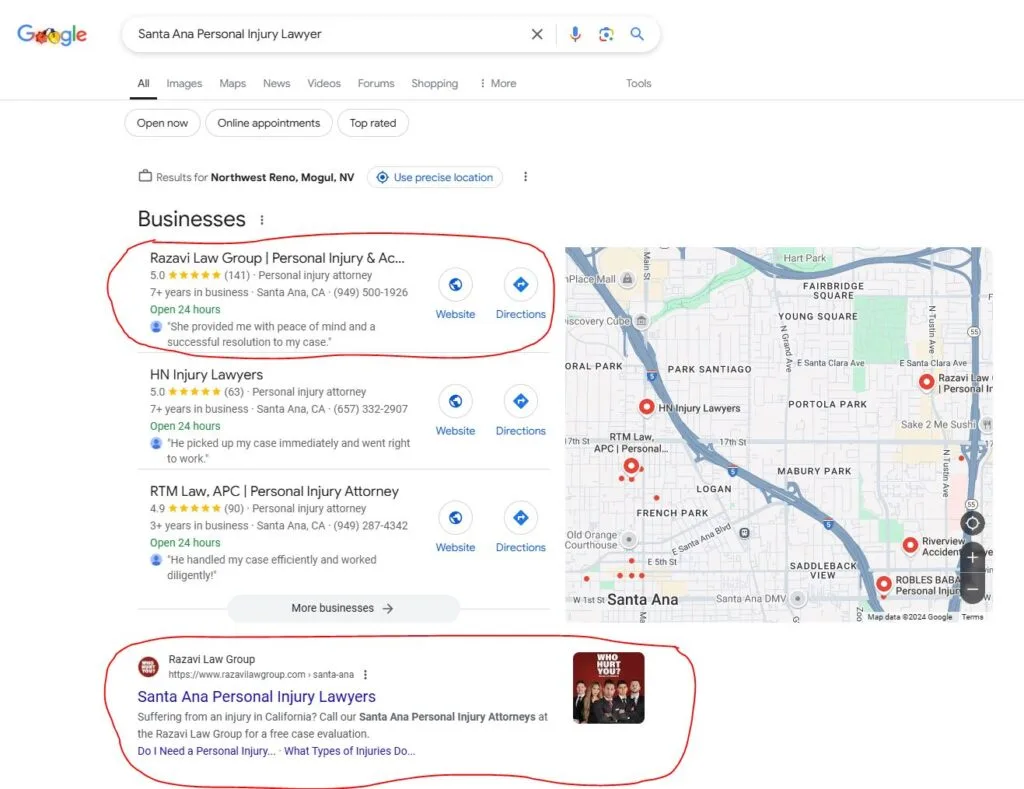
SEO for personal injury lawyers is the work of getting your firm to show up on Google, in the map results and in AI answers when an injured person searches for help in your city. For most firms, the fastest path is a complete Google Business Profile, one strong page for each case type in each city you serve, steady client reviews, and clear answers to the questions injured people actually ask.
This guide covers what personal injury SEO is, why it is so competitive, how to do it step by step, what agencies charge, the mistakes that waste months, and a short plan you can start this week. It is general marketing guidance, not legal advice, and your state bar's advertising rules still apply to everything you publish.
What is personal injury SEO?
Personal injury SEO is the process of optimizing a law firm's website and online profiles so they rank on Google when people search for injury lawyers, such as 'car accident lawyer in Atlanta' or 'what to do after a motorcycle accident in Missouri'. It covers keyword research, practice-area pages, local SEO, content, technical health, reviews and links.
It differs from paid search because you earn visibility instead of buying each click. That makes it slower to start, usually several months of steady work before you see real movement, but it keeps paying off after you stop spending on it.
It also now includes AI answers. Assistants like ChatGPT and Gemini answer questions such as 'how long do I have to file an injury claim', and they pull from pages that are clear, specific and trusted. The habits that win in Google mostly help here too. Our GEO vs SEO guide explains the overlap.
Why is SEO for personal injury lawyers so competitive?
It is competitive because one signed case can be worth thousands of dollars, so many firms in the same city chase the same searches. Agencies, directories and large advertisers all want the top three results for 'personal injury lawyer' plus your city name.
That is the bad news. The good news is that the competition is concentrated on a small set of head terms. Below them sits a long list of specific searches that big firms ignore: a case type plus a neighborhood, a question about a deadline, a question about a specific injury. Small and mid-size firms can win there first, then climb toward the harder terms.
If you want a quick view of how crowded your market is, the Keyword Difficulty Checker and the SERP Checker show who ranks today and how hard they will be to beat.
This video from The Media Captain explains why personal injury SEO is so competitive and how firms can still win:
How to do SEO for a personal injury law firm, step by step
Work in this order. Each step builds on the one before it, and the first three usually matter most for local cases.
Step 1: Build a keyword map around case value
Start with the cases you most want to sign, not the highest search volume. List your case types (car accidents, truck accidents, motorcycle accidents, slip and falls, medical malpractice, wrongful death), your cities and neighborhoods, and the questions clients ask. Then assign each keyword to one page.
| Keyword type | Example | What the searcher wants | Page it belongs on |
|---|---|---|---|
| Case type + city | car accident lawyer Atlanta | To hire a lawyer now | City practice-area page |
| Case type + neighborhood | truck accident attorney near Midtown | A nearby lawyer | Location or neighborhood page |
| Near me | best personal injury lawyer near me | A lawyer close by | Google Business Profile and home page |
| Deadline question | how long do I have to file a personal injury claim in Texas | An answer, often early in the process | Blog article or state guide |
| Injury question | what is the hardest injury to prove | Understanding their case | Blog article |
Tools like Google Keyword Planner give you ideas and volume ranges. The free Long Tail Keyword Generator is useful for the question-style phrases that bigger firms skip. The 'People also ask' box on Google is a free source too: questions like 'What does a personal injury lawyer cover?' and 'What is the hardest injury to prove?' are article topics your future clients are already typing.
Step 2: Create one page per case type per city
A single 'Practice Areas' page cannot rank for ten different searches. Give each case type its own page, and if you serve several cities, give each city its own version with real local content.
Each page should include:
- A clear H1 with the case type and city, such as 'Atlanta Car Accident Lawyer'.
- What the firm handles, who you serve, and what happens after a client calls.
- Local detail: courts, common roads or intersections, local hospitals, and the state's filing deadline.
- A visible phone number and a short contact form above the fold.
- Short FAQs answering real questions in plain English.
- Proof: reviews, case results where your bar rules allow them, and attorney bios.
Avoid copying the same page and swapping the city name. Google treats near-duplicate pages as thin, and clients can tell too.
Step 3: Win the map pack with your Google Business Profile
For 'near me' and city searches, the map results often appear above the regular listings, so your Google Business Profile is one of the highest-value assets you own. Claim it, verify it, and fill in every field.
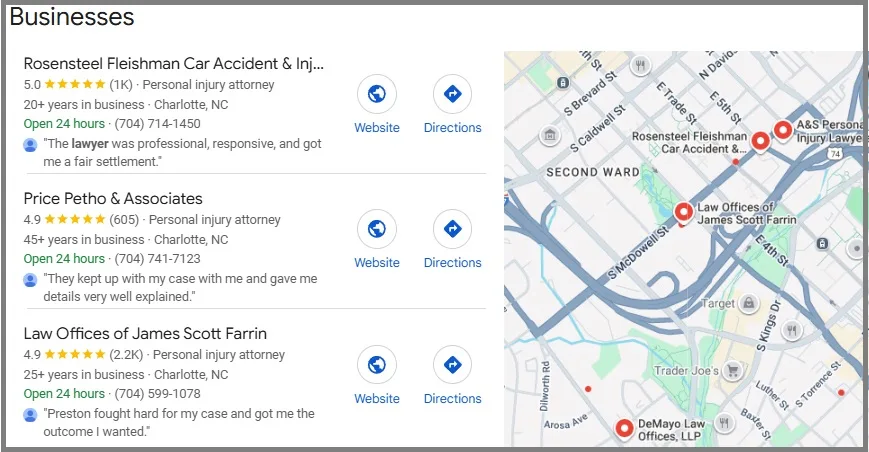
Checklist for the profile:
- Pick the most accurate primary category (such as 'Personal injury attorney') and add secondary categories only where they fit.
- Add accurate hours, phone number, address, website and service areas.
- Upload real photos of your office and team.
- List your services and write a plain description with no keyword stuffing.
- Link to the right page, usually the home page or the location page for that office.
- Answer questions and post updates regularly.
Our Local SEO for Law Firms playbook goes deeper on map rankings, and the free Local SEO Checklist lets you tick through the basics.
Step 4: Collect reviews and keep your name, address and phone number consistent
Reviews help you rank and help people choose you. Ask satisfied clients at a natural moment, such as when a case settles, and give them a direct link to your Google review form. Reply to every review in a calm, professional tone, and never reveal case details in a reply.
Your name, address and phone number (NAP) should be identical on your website, Google Business Profile, Avvo, Justia, bar association listings and local directories. Small mismatches like 'Suite 200' versus 'Ste. 200' are minor, but a different phone number or an old address can confuse Google about which listing is yours.
Step 5: Publish content that answers real client questions
Injured people have a lot of questions before they ever call a lawyer. Content that answers them gives you more chances to be found and builds trust before the first call.
Good article ideas for a PI firm:
- What to do after a car accident, hit-and-run or motorcycle crash in your state.
- How long you have to file a personal injury claim in your state.
- What a personal injury lawyer covers, and what they do not.
- Which injuries are hardest to prove, and what evidence helps.
- How contingency fees and case costs work, and how a settlement is divided in general terms.
- What to do when the other driver's insurer calls.
Write each one for a single question, answer it in the first two sentences, then add detail, a short FAQ and a prompt to call. Keep facts accurate for your state, and have an attorney review anything that touches the law. Content also needs to be fresh and kept up to date, so schedule a review of your top pages every few months.
Step 6: Fix the technical basics
Technical problems quietly cap your rankings. You do not need perfection, just a site that is fast, secure and easy to crawl.
- Use HTTPS on every page.
- Make sure the site works well on phones. Mobile makes up a large share of US organic search visits, according to Statista.
- Compress images and cut unneeded scripts so pages load quickly.
- Keep titles under about 60 characters and meta descriptions under about 160, as the Meta Description Length Checker can confirm.
- Add structured data so Google understands your firm. The Local Business Schema Generator creates the code to paste in.
Step 7: Earn links from relevant legal and local sources
Links from trusted sites signal authority. For a law firm, the most realistic sources are bar association pages, legal directories such as Avvo and Justia, local news mentions, community sponsorships, and guest articles for legal or local publications.
Chase relevance over volume. Five links from respected local or legal sites are worth more than fifty from random blogs. You can check your current profile with the free Backlink Checker.
Step 8: Track calls and signed cases, not just rankings
A first-page ranking means little if it brings no cases. Track organic traffic and keyword positions in Google Search Console and Google Analytics, and set up call tracking and form tracking so you can see which pages produce inquiries. Then ask your intake team where each signed client found you.
The free Keyword Rank Checker is a quick way to see where you stand for your top ten local searches before you start and again each month.
How much does personal injury SEO cost?
Costs range from a few hundred dollars a month for a bundled website and SEO plan to well over $10,000 a month for a large agency in a competitive metro. Web Tonic's 2026 roundup of 20 injury law SEO agencies lists published or estimated rates for some of them.
| Option | Listed monthly price | Notes |
|---|---|---|
| Civille (website and SEO bundles) | $299 to $899 | SEO scopes listed from $500 to $10,000 |
| AuthoritySpecialist | $2,500 | Retainer for multi-office firms |
| Acute SEO | $2,500 | City-level PI SEO |
| Inoriseo | $2,700 | Law-firm-only SEO |
| BluShark Digital | $8,000 to $15,000 | Estimate from third-party reviews |
Most other agencies on that list quote by scope. Treat these numbers as a rough guide and ask each agency for current pricing, contract length and what is included. Our free SEO Cost Calculator and SEO ROI Calculator help you work out what a signed case is worth against the monthly spend.
Should you do it yourself or hire an agency?
DIY works if someone on your team has real time, ideally a few hours a week, and you stay consistent for at least several months. The hidden cost is billable time: every hour spent on keyword research or site fixes is an hour not spent on cases.
| Approach | Best for | Main risk |
|---|---|---|
| DIY | Solo lawyers or new firms with more time than budget | Inconsistent execution |
| Law-focused agency | Firms in dense metros that can afford a retainer | Cost, and slow reporting if you pick poorly |
| Hybrid (tools plus an automated content workflow) | Small firms that want steady publishing without a retainer | You still own the profile, reviews and intake |
Common personal injury SEO mistakes
These are the ones that waste the most time:
- One page for everything. A single 'Practice Areas' page cannot rank for every case type and city.
- Copy-paste city pages. Swapping the city name does not create a useful page.
- Ignoring the Google Business Profile. Many map pack wins come from a complete, active profile and reviews.
- Inconsistent NAP details. Old addresses and phone numbers confuse Google and clients.
- Publishing and abandoning. Four posts in January and nothing until June builds little momentum.
- Tracking rankings only. Rankings do not pay the bills. Calls and signed cases do.
- Ignoring bar rules. Claims about results, specialization or guarantees can break advertising rules in your state.
Tools for personal injury SEO
You do not need every tool. A small set covers most of the work.
| Job | Tool | Cost |
|---|---|---|
| Keyword ideas and volumes | Google Keyword Planner | Free with a Google Ads account |
| Competitor research and tracking | Semrush or Ahrefs | Paid |
| Traffic and lead tracking | Google Search Console and Google Analytics | Free |
| Quick keyword and rank checks | Rankfly free SEO tools | Free |
| Schema markup | Local Business Schema Generator | Free |
| Content, publishing and AI answer tracking | Rankfly | $66/month |
Where Rankfly fits
Rankfly is an SEO autopilot built for small teams that want content researched, written and published for them. It scores keywords for how winnable they are against your site's authority, builds a 30-day content calendar, and writes one article a day with sources, internal links and an FAQ. Review mode lets an attorney approve each article before it goes live, which matters for a law firm.
It also tracks whether ChatGPT, Claude, Gemini and Perplexity recommend you for the questions buyers ask, using the AI visibility tracker. Rankfly is not a full SEO suite like Semrush or Ahrefs, and it does not manage your Google Business Profile or collect reviews. It covers the content engine, which is the part most busy firms drop. It costs $66 a month for 30 articles, with a 3-day free trial. Details are on the law firm page.
A plan you can follow this week
You can make real progress in five short sessions.
- Monday: audit. Search your five most important keywords in a private window and note who appears. Run the Local SEO Checklist against your site and profile.
- Tuesday: Google Business Profile. Fill every field, add photos, fix any NAP mismatches and send review requests to your last five happy clients.
- Wednesday: one money page. Pick your best case type and city and write or rewrite that page using the checklist in Step 2.
- Thursday: one question article. Choose a question from 'People also ask', such as what a personal injury lawyer covers, and answer it in the first two sentences.
- Friday: tracking. Set up Search Console, call tracking and a simple sheet that records calls, signed cases and sources each month.
Then repeat: one new page or article per week, one review request per closed case, and a monthly check of rankings and leads.
Final thoughts
Personal injury SEO rewards firms that are specific and consistent: a strong Google Business Profile, a page for each case type and city, steady reviews and helpful answers to real questions. Start with the five-day plan above, and if you would rather not write and publish every article yourself, see how Rankfly does it for law firms.
Frequently asked questions
How long does SEO take to work for a personal injury law firm?
Expect several months of consistent work before you see measurable movement. Map pack and long-tail rankings often move first, while competitive terms like 'personal injury lawyer' plus a large city can take longer. Results depend on your market, your site's current authority and how steadily you publish.
What does a personal injury lawyer cover?
A personal injury lawyer handles claims where someone is harmed because of another party's negligence or wrongdoing, such as car accidents, slip and falls, medical malpractice, workplace injuries and wrongful death. The exact cases a firm takes vary, so your website should say clearly which ones you handle.
How much of a $25,000 settlement will a client get?
It depends on the fee agreement, case costs and any medical liens. Many personal injury firms work on contingency, commonly around a third of the settlement, but percentages and rules vary by state and by case stage. This is general information, not legal advice, so clients should check their own agreement.
What is the hardest injury to prove?
Injuries without clear visible evidence, such as soft tissue injuries, chronic pain and some concussions, are often harder to prove because they depend on medical records, consistent treatment and credible documentation. A firm can turn this into a useful article by explaining what evidence helps.
Is local SEO or content more important for personal injury lawyers?
Local SEO usually pays off first, because most searches have a location attached and the map results appear above regular listings. Content supports it by earning traffic from question searches and building trust. You need both, but start with your Google Business Profile and case-type pages.
Can a small firm compete with big personal injury advertisers on Google?
Yes, if it competes on specifics instead of head terms. Target case types in particular cities and neighborhoods, answer questions in your state, collect reviews and publish consistently. Those searches are less crowded and often come from people closer to hiring.
About the editorial team
Emma writes Rankfly's guides on SEO, AI search and getting small businesses found on Google and ChatGPT.