Best ChatGPT SEO Tools: Trackers, Prompts and Optimizers
The best ChatGPT SEO tools, ranked: trackers that show if ChatGPT recommends you, prompt lists you can copy, and the free tools that get your site found.

See if ChatGPT recommends you
Rankfly tracks your visibility in ChatGPT, Claude, Gemini and Perplexity, then writes the articles that close the gaps.
Check my AI visibilityKey takeaways
- ChatGPT SEO tools fall into three groups: trackers that measure whether ChatGPT mentions you, prompts you run yourself, and optimizers that fix indexing and content.
- ChatGPT pulls from traditional search engines like Bing and Google, so indexing in both is the cheapest first step.
- You can start tracking for free by running the same buyer questions in ChatGPT each month and logging whether you are mentioned and which sources it cites.
- Paid trackers save time once you track more than a handful of questions or want competitor comparisons.
- Fix the gaps the tracker finds with direct, well-structured articles that answer the exact question.
Table of contents
The best ChatGPT SEO tools fall into three groups: trackers that show whether ChatGPT mentions your brand, prompts you run yourself to research and write, and optimizers that fix what stops AI tools from finding you. For most small businesses, one tracker plus correct indexing in Bing and Google covers most of the work.
A ChatGPT SEO tool is any software or workflow that helps your brand get found, cited or recommended in ChatGPT answers, or that uses ChatGPT to speed up regular SEO work. This list covers both meanings, because readers search for both.
That gap is the reason to start small. The channel is real and growing, but it is not yet a replacement for Google, so you want cheap tracking and a few focused fixes, not a new tool stack.
Quick picks: the best ChatGPT SEO tools at a glance
Pricing below is only listed where it is sourced. For everything else, check the vendor's current pricing page.
| Tool | Best for | Starting price | Standout feature |
|---|---|---|---|
| Rankfly | Small teams that want tracking plus articles written and published for them | $66/month, 3-day free trial | Tracks ChatGPT, Claude, Gemini and Perplexity, then turns gaps into articles |
| Semrush AI Visibility Toolkit | Researching which pages and sources ChatGPT cites | Check current pricing | Cited Sources and question-level reports |
| SE Ranking | Tracking brand mentions and citations in AI answers | Check current pricing | Dedicated generative engine optimization tool |
| Manual prompt tracking in ChatGPT | Free spot checks and a first baseline | Free plan available | Exact buyer questions, your own log |
| Bing Webmaster Tools, IndexNow and Google Search Console | Getting indexed so ChatGPT can find you | Free | Sitemap submission and indexing reports |
| Rankfly free SEO tools | Quick checks on AI visibility and crawl access | Free | AI visibility checker and robots.txt checker |
| Coursera: AI SEO with ChatGPT | Learning the workflows step by step | Included with Coursera Plus | 4-hour beginner course |
1. Rankfly: best for tracking plus fixing the gaps
Rankfly is an SEO autopilot for small businesses, founders and marketers who want traffic from Google and AI assistants without doing the SEO themselves. It is our own tool, so weigh this entry accordingly.
The tracking side asks ChatGPT, Claude, Gemini and Perplexity the questions your buyers ask. It reports a visibility score, share of voice, position, sentiment and cited sources, compared against up to 3 competitors across 20 tracked questions. Where a competitor is recommended and you are not, that gap becomes an article. Each article is re-checked 14 days after it goes live, so you see whether the fix worked.
The writing side researches the current top 10 results and the questions people ask, then writes one SEO article a day in your brand voice, with internal links, sources, an FAQ and a featured image. It publishes to WordPress, Shopify, Webflow, Wix, Framer, Ghost, Notion or any site through a webhook or REST API, and review mode lets you approve each article first. See how that works on the AI autoblogging page.
Pros
- Tracking and content in one place, so a gap leads straight to a fix.
- Competitor comparison and sentiment, not just a yes/no mention check.
- $66/month covers 30 articles plus tracking, with a 3-day free trial and cancel anytime.
Cons
- Not a full SEO suite like Semrush or Ahrefs. It does not replace deep backlink or technical audit tooling.
- Tracking is capped at 20 questions and up to 3 competitors.
- Built for people who want content done for them. If you prefer to write everything yourself, it is more than you need.
2. Semrush AI Visibility Toolkit: best for citation research
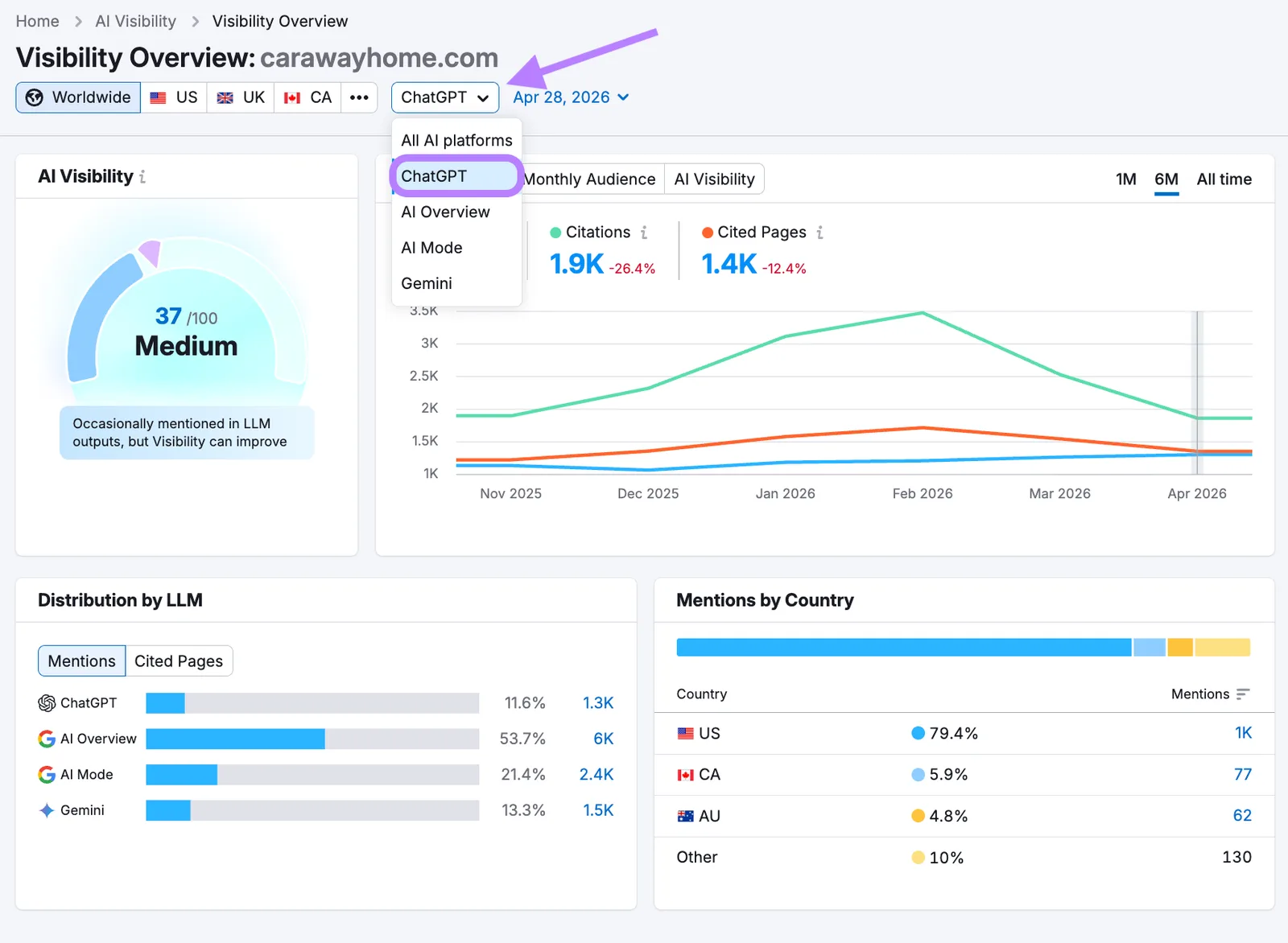
Semrush's AI Visibility Toolkit is the most useful option here if you want to see which of your pages ChatGPT links to and which outside sites it trusts. In Semrush's own walkthrough, the Cited Sources report lists the top websites ChatGPT cites for queries related to a brand. Those sites are natural targets for backlinks and brand mentions.
The Narrative Drivers report is the other standout. Filter by ChatGPT, then filter the question breakdown to "Not present" and you get a list of questions where your brand is missing. That is a ready-made content plan.
Pros
- Shows cited pages, not just whether you were mentioned.
- Cited Sources gives you outreach targets for mentions and links.
- Sits inside a full SEO platform, so you can compare AI citations with Google rankings.
Cons
- Built for people comfortable with a large SEO platform, which can be heavy for a small team.
- Pricing is not listed here, so check the current plans before you commit.
- It finds gaps but does not write or publish the content to close them.
3. SE Ranking: best for monitoring mentions and citations
SE Ranking has a dedicated generative engine optimization tool. One agency guide on ChatGPT SEO points to it for tracking brand mentions, citations in AI responses and overall visibility across generative engines. That is the core of what you need to measure.
Pros
- Purpose-built for AI mention and citation tracking.
- Good fit if you already use SE Ranking for rank tracking.
Cons
- Details on plans and limits are not covered here, so check the current pricing page.
- Like most trackers, it reports the problem and leaves the fix to you.
If you want a wider comparison of trackers, read our guide to the best AI visibility tools.
4. Manual prompt tracking in ChatGPT: best free starting point
You do not need software to get a baseline. Open ChatGPT, ask the questions a buyer would ask, and write down what comes back. Semrush's guide suggests the same approach: test whether ChatGPT cites or mentions your brand in response to relevant prompts, and note which sources it cites most often.
Pros
- Free and takes about an hour for a first baseline.
- You see the exact wording of the answer, which no dashboard fully replaces.
Cons
- Answers vary from run to run, so one check proves little.
- It does not scale past a few dozen questions, and you have to build the log yourself.
The prompt lists below give you a starting set and a log format.
5. Bing Webmaster Tools, IndexNow and Google Search Console: best for getting indexed
ChatGPT searches the web through traditional search engines. Semrush states that ChatGPT uses both Bing and Google, and its own research covers the Google side. If a page is not indexed in either, it is less likely to show up in answers.
The setup is free:
- Add your site to Bing Webmaster Tools and submit your XML sitemap in the Sitemaps section.
- Use Site Explorer to find pages with crawl errors, robots.txt blocks or accidental noindex tags.
- Set up IndexNow so Bing is notified when you publish or update a page.
- In Google Search Console, submit the sitemap and work through the "Why pages aren't indexed" list in the Pages report.
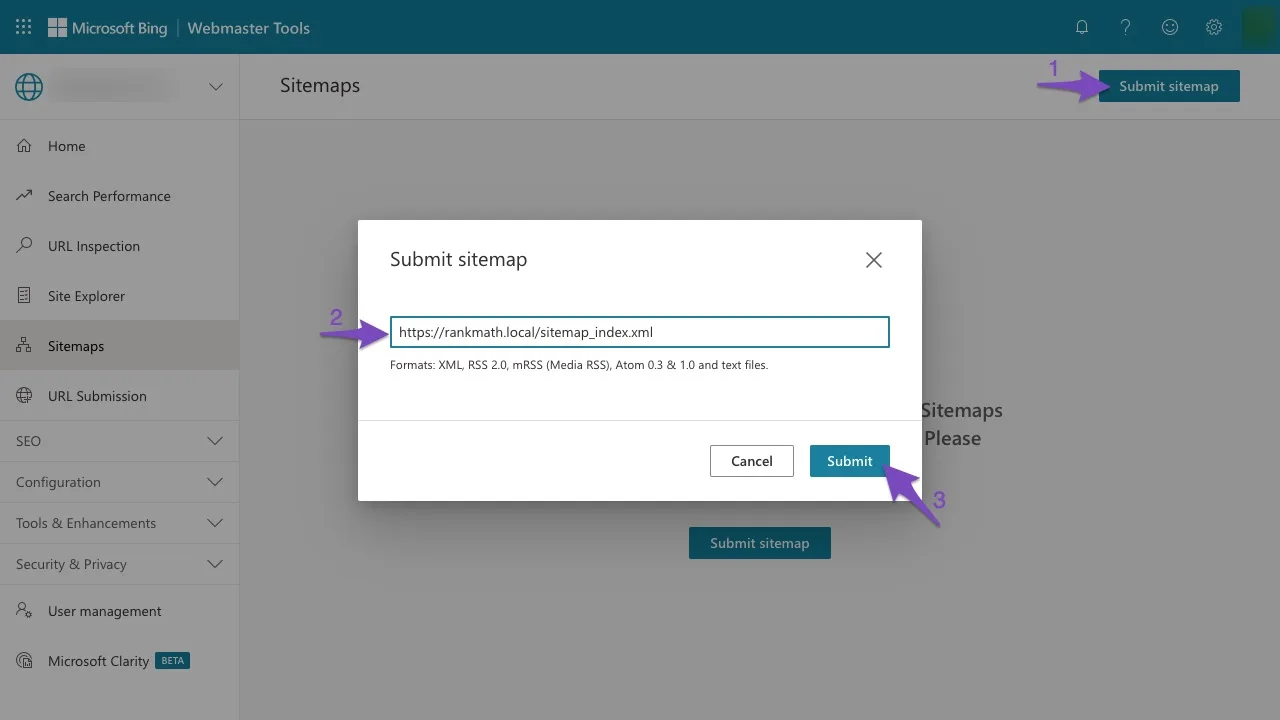
Also check that you are not blocking OpenAI's search crawler. An older robots.txt that blocks AI bots can keep you out. To allow it, add:
User-agent: OAI-SearchBot
Allow: /
You can confirm the result with the free Robots.txt Checker, or see our WordPress robots.txt guide for a full setup.
Pros
- Free, official and useful for Google and Bing results too.
- Fixes the most common reason a page never gets cited: it was never indexed.
Cons
- It tells you nothing about whether ChatGPT mentions you.
- Indexing is necessary, not sufficient. You still need content worth citing.
6. Rankfly free SEO tools: best for quick checks
Rankfly also has free SEO tools that cover the quick checks around ChatGPT visibility. The Free AI Visibility Checker gives you a fast read on how AI assistants treat your brand before you set up anything ongoing. The Free AI SEO Audit and Free llms.txt Generator sit alongside it. Treat llms.txt as optional housekeeping, since this research does not show that it changes ChatGPT citations.
For the ChatGPT-as-writing-assistant side, the free Keyword Generator is a better source of keyword ideas than a chat prompt, because ChatGPT cannot give you reliable search volume.
Pros
- Free and fast, no setup.
- Good for a one-off check or to sanity-check a ChatGPT answer.
Cons
- One-off checks, not ongoing tracking over time.
- Narrower than a paid platform.
7. Coursera: AI SEO with ChatGPT: best for learning the workflows
If you want to learn how to use ChatGPT inside your SEO process, AI SEO with ChatGPT is a beginner course that takes about 4 hours. Its first module has 11 short videos covering keyword generation, long-tail keywords, headlines, meta descriptions, backlink research and competitor analysis. It is included with Coursera Plus, and certificate access depends on how you enroll.
Pros
- Structured, beginner-level, no prior SEO knowledge needed.
- Covers the prompt-based side of ChatGPT SEO.
Cons
- It teaches using ChatGPT for SEO tasks. It does not track whether ChatGPT recommends your brand.
- You still have to do the work afterward.
ChatGPT SEO prompts you can copy
There are two kinds of prompts. One set tracks your visibility. The other helps you do SEO work faster.
Prompts for tracking whether ChatGPT recommends you
Use specific questions. Semrush notes that ChatGPT prompts tend to be more detailed than Google keywords, with real constraints attached, for example asking which feeder works for a household with both cats and dogs. Mirror that detail.
| Prompt type | Template | What it shows |
|---|---|---|
| Recommendation | What are the best [category] for [specific customer] in [city]? | Whether you appear on shortlists |
| Comparison | [Your brand] vs [competitor]: which is better for [use case]? | How you are described next to rivals |
| Problem | How do I [problem your product solves]? | Whether your guides get cited |
| Constraint | Can you recommend a [product] for [situation with two or three constraints]? | Visibility on high-intent, long questions |
| Alternatives | What are good alternatives to [competitor]? | Whether you are named as the other option |
| Cost | How much does [service] cost in [city]? | Whether your pricing pages are used |
For each prompt, log five things in a spreadsheet: the date, the prompt, whether you were mentioned, your position in the list, and the sources cited. Run it in a fresh chat with search enabled, and repeat monthly. Look at the cited sources first, because those are the sites you need a mention on.
Prompts for using ChatGPT to do SEO work
These are the prompts to paste into ChatGPT when you want a first draft of something. Always check the output yourself.
- Keyword ideas: "List 30 long-tail questions a [customer type] would ask before buying [product]. Group them by intent: learn, compare, buy."
- Content gaps: "Here are the headings of the top 5 pages for [keyword]. What questions do they not answer?"
- Direct answers: "Rewrite the first sentence under this heading so it answers the question in one sentence that starts by repeating the heading's wording."
- Meta descriptions: "Write 5 meta descriptions under 155 characters for a page about [topic]. Include [keyword] and one reason to click."
- FAQ: "Write 5 questions people ask about [topic], each answered in 2 to 3 sentences."
- Freshness audit: "Here is my article. Flag any statistic or claim that may be out of date."
The direct-answer prompt matters most. Semrush's guidance is to answer the heading's question immediately, so that, for example, a section titled "What is SEO?" opens with "SEO is...". That structure is also easy for AI tools to extract.
For longer content, our content SEO writing guide and the free Content Brief Generator pair well with these prompts.
How to choose the right ChatGPT SEO tool
Start with what you actually need to know, then pick the cheapest tool that answers it.
| Your situation | Pick | Why |
|---|---|---|
| You have never checked if ChatGPT mentions you | Manual prompt tracking plus the free AI Visibility Checker | Free baseline in an afternoon |
| Your site may not be indexed well | Bing Webmaster Tools, IndexNow and Google Search Console | ChatGPT relies on search engine indexes |
| You want to find the sites ChatGPT cites in your niche | Semrush AI Visibility Toolkit | Cited Sources report |
| You already use SE Ranking | SE Ranking's GEO tool | Keeps everything in one dashboard |
| You want tracking and the articles to close gaps, with little hands-on work | Rankfly | Gaps become articles, published automatically |
| You want to learn the prompt workflows yourself | Coursera course | Structured and beginner-friendly |
A practical order for most small teams:
- Confirm your pages are indexed in Bing and Google and that OAI-SearchBot is allowed.
- Run 10 to 20 buyer questions manually and record the results.
- Note which questions name competitors and not you, and which sources are cited.
- Write direct, well-structured answers for those gaps, and pursue mentions on the sources that ChatGPT already cites.
- Re-check after a few weeks.
If you are unsure how this differs from regular SEO, read GEO vs SEO. The short version is that the basics overlap: quality content, clear structure and authority signals help in both.
Final thoughts
The best ChatGPT SEO tool is the one that tells you where you are missing and helps you fix it. Start with free indexing checks and a manual prompt log, then add a tracker once you need competitor comparisons or more than a handful of questions. If you want tracking and the articles to close the gaps in one place, try Rankfly.
Frequently asked questions
Is there a tool that tells me if ChatGPT recommends my business?
Yes. AI visibility trackers such as Rankfly, the Semrush AI Visibility Toolkit and SE Ranking's generative engine optimization tool check whether AI assistants mention or cite your brand. You can also do it free by asking ChatGPT your buyers' questions and logging the answers.
Can ChatGPT do keyword research for SEO?
It is useful for brainstorming long-tail questions, grouping them by intent and spotting content gaps. It cannot give reliable search volume or difficulty, so confirm ideas with a keyword tool before you write.
How do I get my website cited by ChatGPT?
Make sure your pages are indexed in Bing and Google, allow OAI-SearchBot in robots.txt, and write pages that answer the question directly under a clear heading. Mentions on sites that ChatGPT already cites also help.
Do I need to rank on Google to appear in ChatGPT?
Not strictly, but the two overlap. ChatGPT uses search engines like Bing and Google when it searches the web, and Semrush's analysis of one brand found that most of its ChatGPT-cited pages also ranked for at least one Google keyword.
Are free ChatGPT SEO tools good enough?
For a baseline, yes. Manual prompt checks, Bing Webmaster Tools, Google Search Console and free checkers cover indexing and a first look at visibility. Paid tools make sense when you need ongoing tracking, competitor comparison or content produced for you.
About the editorial team
Emma writes Rankfly's guides on SEO, AI search and getting small businesses found on Google and ChatGPT.